As the demand for renewable energy accelerates, so does the pressure on land resources. The question is no longer simply how to generate clean energy—but how to do so in ways that strengthen, rather than compete with, agricultural and ecological systems.
That’s where agrivoltaics enters the conversation.
According to Sustainable Systems Engineering instructor and Education Manager for the Wisconsin Energy Institute, Scott Williams, agrivoltaics is fundamentally about maximizing the value of land. “Put simply, it’s using a plot of land for both solar power generation and agriculture,” he explains. “The goal is to get the land to do double-duty.”
What makes the concept particularly timely is the rapid drop in solar costs over the past decade. Solar energy is now economically viable in far more regions than before—including the Midwest. As developers seek open, relatively flat land suitable for solar arrays, agricultural land often meets the criteria. But that opportunity also raises important concerns about preserving farmland and rural livelihoods.
Agrivoltaics offers a potential path forward—one that reduces trade-offs between food production and clean energy development.
A Midwest-Focused Research Perspective
Much of the early agrivoltaics research in the United States occurred in the Southwest, where abundant sunshine and dry climates shaped system design. But those models don’t always translate to regions like Wisconsin.
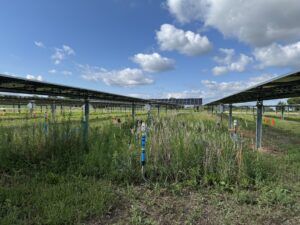
That’s why research at the University of Wisconsin–Madison’s Kegonsa Research Campus, spearheaded by the UW-Madison Office of Sustainability and other campus groups in partnership with Alliant Energy, is taking a regionally grounded approach—testing crops suited to Midwestern conditions, such as forage crops and shade-tolerant berries.
What distinguishes this work is its systems-level lens.
Researchers are not only studying crop yields and solar array performance but also measuring broader environmental outcomes—tracking soil health, water movement, carbon flow, and wildlife activity. Sensors monitor environmental conditions across the site, while specially designed habitats help researchers observe pollinator populations.
“The overall goal,” Williams notes, “is to understand how agrivoltaics can be designed to benefit the surrounding agricultural and ecological systems—not just produce electricity.”
This holistic approach reflects a growing recognition across the energy sector: sustainable infrastructure must account for ecological, social, and economic outcomes simultaneously.
From Concept to Practice: Emerging Models
While agrivoltaics is still evolving, several promising models are already gaining traction.
One widely adopted approach involves livestock grazing—particularly sheep—within solar arrays. These animals provide natural vegetation management while allowing farmers to maintain agricultural production on the same land. Recent student research projects have explored how these systems can generate both economic and environmental advantages compared to single-use land models.
Another emerging model, sometimes called ecovoltaics, integrates native grasses and wildflowers around solar installations. These plantings help reduce water runoff, improve soil carbon storage, and create habitat for beneficial insects and wildlife. In turn, neighboring farms may benefit from increased pollination and natural pest management.
“The beauty of agrivoltaics,” Williams explains, “is that there’s no one-size-fits-all solution. Systems can vary and be combined depending on local conditions.”
That adaptability may be key to scaling the approach across diverse agricultural regions.
The Data Challenge and Opportunity
Despite its promise, widespread adoption of agrivoltaics will require patience—and data.
Because plant growth and ecosystem changes take time to measure, long-term research is essential to understanding what works across different climates, soils, and agricultural systems.
Facilities like the Kegonsa site serve as living laboratories—spaces where researchers can test new ideas, refine system designs, and generate the evidence needed to inform policy, investment, and infrastructure decisions.
For Williams, this ongoing experimentation is not a limitation but an opportunity.
“The questions are evolving,” he says. “And the ability to continually gather new data is what will ultimately make agrivoltaics scalable.”
Preparing the Next Generation of Energy Leaders
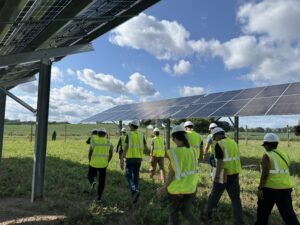
Thought leadership in emerging fields like agrivoltaics does more than advance research—it shapes education.
Within the Sustainable Systems Engineering program, students engage directly with topics like agrivoltaics concepts through coursework, guest speakers, and applied projects. Interdisciplinary collaboration—across engineering, agriculture, ecology, and policy—mirrors the complexity of real-world energy challenges.
That interdisciplinary mindset is central to Williams’ teaching philosophy.
“The situation is so complex that it takes smart, motivated people from all walks of life working together,” he says. “Anyone who wants to go into sustainable energy can find their place.”
A Systems-Level Vision for Sustainable Energy
Agrivoltaics represents more than a technological innovation. It signals a broader shift in how energy systems are designed—moving from single-purpose infrastructure to integrated, multifunctional landscapes.
That shift requires leaders who think in systems, not silos.
Through regionally grounded research, interdisciplinary collaboration, and applied education, faculty like Williams are helping define what responsible renewable energy deployment looks like in practice.
And as agrivoltaics continues to evolve, the institutions advancing these conversations today will help shape the energy landscapes of tomorrow.
Learn more about the UW-Madison Online Sustainable Systems Engineering Master’s Program here.